WHAT EACH PLANETARY DAY IS FOR, IN THE KEY'S WORDS
Before the Key of Solomon tells you how to do anything, it tells you when. Not vaguely - it runs through the seven planets in order and lists, for each, the works proper to its days and hours. Modern retellings compress this into a mood board. The original is a schedule.
Venus, and the Sun
The Days and Hours of Venus are good for forming friendships; for kindness and love; for joyous and pleasant undertakings, and for travelling.Key of Solomon, Book I (Mathers ed., 1889, public domain)
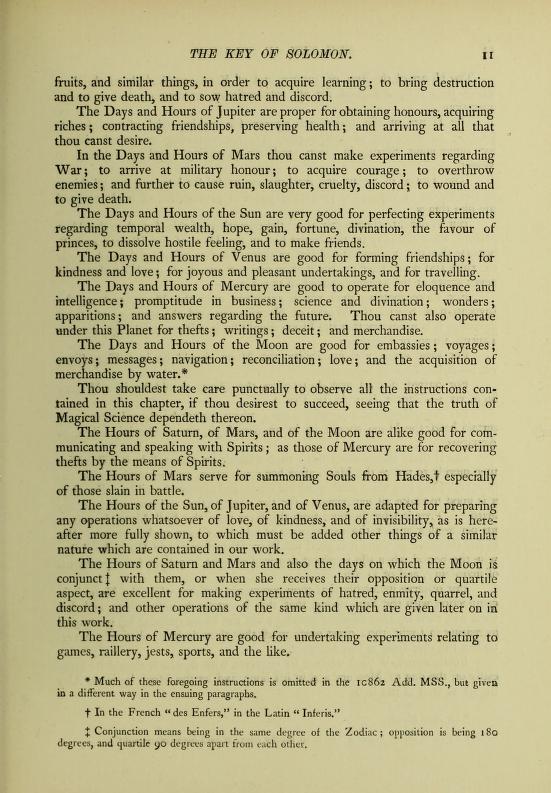
And immediately before it, the Sun:
The Days and Hours of the Sun are very good for perfecting experiments regarding temporal wealth, hope, gain, fortune, divination, the favour of princes, to dissolve hostile feeling, and to make friends.
Read them together and the character of the list becomes obvious. These are not spiritual categories. They are the practical concerns of a person in the late medieval world - friendship, travel, money, standing with those in power, lawsuits, illness. The system is a calendar for ordinary business, not a mystical taxonomy.
Saturn gets the difficult work
Saturn's entry is where the modern reader usually stops short. The text assigns to its days and hours the summoning of souls from Hades - though it restricts this, oddly and specifically, to those who died a natural death - along with bringing good or ill fortune to buildings, business, possessions, seeds and fruits.
We quote that rather than soften it. The book is what it is, and a guide that tidies its source is no longer describing the source.
Rite, instrument, honest gap
Rite
The Key assigns each planet a list of operations proper to its days and hours, and treats the timing as binding rather than advisory. The lists are given in Book I and are specific enough to function as a schedule.
Instrument
Which planet rules a given hour is pure arithmetic. Divide daylight by twelve and night by twelve, name the first hour of the day after that day's ruler, then run the Chaldean order forward. You can solve any hour, anywhere, on any date, and check the result against a sunrise table.
The weekday names are the fingerprint of that arithmetic still in plain sight. Run the sequence forward twenty-four hours and it lands exactly on the next day's ruler, which is why Saturday is followed by Sunday and then Monday.
Honest gap
Whether an hour of Venus favours friendship is a claim no instrument touches, and we make none. What is provable is the internal consistency of the system and its survival in the names of our days.
The one thing worth saying against the sceptical reading: the compilers were not being arbitrary. They had a coherent scheme, applied it consistently, and left it checkable. Being coherent is not the same as being correct, and both statements can stand.
Questions the sources get asked
What are the days and hours of Venus good for?
In the Key's own words, for forming friendships, for kindness and love, for joyous and pleasant undertakings, and for travelling. The text gives comparable lists for each of the seven planets.
Which planet rules today?
Saturday belongs to Saturn, Sunday to the Sun, Monday to the Moon, Tuesday to Mars, Wednesday to Mercury, Thursday to Jupiter and Friday to Venus. The weekday names preserve the assignment directly in English, French and the Romance languages.
Does the day matter, or only the hour?
The Key treats both as conditions and regards the combination as strongest - an hour of Venus falling on the day of Venus. Hours of a planet occur on every day of the week, so the two conditions coincide only some of the time.
The Solomonic Guide computes the next windows of your planet from real sunrise at your coordinates, and prints the procedure so you can solve any hour without us.
The Solomonic Guide · $18.98